NMN Supplements: The Efficacy and Safety of NMN | Purovitalis
0

table of contents

For over a decade, NMN has been a focus of scientific interest due to its role in supporting cellular energy production and maintaining NAD⁺ levels — a key factor in metabolic health and aging.
Animal studies have consistently shown promising effects: improved endurance, enhanced mitochondrial function, and signs of slowed biological aging.

However, many of the claims about NMN’s effects in humans have so far relied on preclinical data. This has led to criticism, especially due to the lack of clinical evidence on its effectiveness and — just as importantly — its safety in healthy individuals.

That uncertainty now appears to be addressed. A new randomized, placebo-controlled clinical trial has examined both the efficacy and safety of NMN supplementation in healthy middle-aged adults — and the results offer fresh insight into its potential role in human health, energy, and longevity.

Purpose of the study

Researchers from the US, China, Netherlands, and India have joined forces to conduct a human clinical trial on the efficacy of NMN, the results of which have been published in the GeroScience Journal in December 2022.

The study was titled: The efficacy and safety of β-nicotinamide mononucleotide (NMN) supplementation in healthy middle-aged adults: a randomized, multicenter, double-blind, placebo-controlled, parallel-group, dose-dependent clinical trial.

This clinical trial was designed to evaluate how NMN supplementation affects healthy adults in midlife. A total of 80 participants between the ages of 40 and 65 took part in the study. They were randomly assigned to receive either a placebo or a daily oral dose of NMN — 300 mg, 600 mg, or 900 mg — for 60 days.

The study followed a rigorous design: it was randomized, double-blind, and placebo-controlled, meaning neither participants nor researchers knew who received NMN and who received the placebo during the trial period.

The primary aim of the study was to measure changes in blood NAD⁺ levels.

In addition, the researchers assessed several secondary outcomes:

How the study was conducted

This was a randomized, double-blind, placebo-controlled, parallel-group, dose-dependent, multicenter clinical trial — a methodologically solid design commonly used in clinical research to ensure reliable and unbiased results.

The study included 80 healthy adults between 40 and 65 years old. Participants were randomly assigned to one of four groups: three NMN groups (300 mg, 600 mg, and 900 mg) and one placebo group. Each participant took their assigned capsules once daily for 60 days before breakfast.

The NMN capsules contained 150 mg of pure β-nicotinamide mononucleotide. The placebo capsules were identical in appearance and filled with 150 mg of rice flour.

Group overview

GroupDaily intake
Placebo Group2–6 placebo capsules (150 mg rice flour each)
300 mg NMN Group2 × 150 mg NMN
600 mg NMN Group4 × 150 mg NMN
900 mg NMN Group6 × 150 mg NMN
20 participants per group, for a total of 80 participants.

Inclusion and exclusion criteria

Eligible participants were healthy adults within the specified age range. Exclusion criteria included the use of NAD-related supplements before the trial, current use of statins, smoking, recent drug or alcohol misuse, or participation in other clinical studies.
Pregnant or breastfeeding women were excluded, and all female participants underwent a urine pregnancy test before enrolment.

Assessments and tests conducted

Participants were randomly assigned to one of four groups on day 0. Baseline measurements were taken prior to any supplementation. Follow-up assessments were performed on day 30 and day 60 to evaluate both efficacy and safety.

Here is an overview of the assessments conducted:

NAD⁺ concentration in the blood

The primary endpoint was the change in blood NAD⁺ levels.

A validated colorimetric assay was used to quantify total NAD⁺ and NADH in serum.
Significant, dose-dependent increases in NAD levels were observed in all NMN groups compared to both baseline and placebo. Blood was collected on day 0, day 30, and day 60.

Colorimetric test

A colorimetric test is a lab method that measures the concentration of a substance based on a color change. In this study, the test was used to detect total levels of NAD⁺ and NADH in the blood serum. The stronger the color signal, the higher the concentration.

Safety and tolerability of NMN supplementation

One of the secondary objectives was to evaluate the safety and tolerability of NMN supplementation.
To do this, researchers conducted blood and urine tests, as well as physical examinations throughout the study period. Any adverse events were recorded and monitored. Tolerability was also assessed by tracking whether participants completed the trial — and notably, no one in any group dropped out.

6-minute walking test

The 6-minute walking test was conducted on day 0, 30, and 60 to assess endurance.
Participants were instructed to walk as far as possible within 6 minutes, and the total walking distance was recorded. This served as one of the secondary outcome measures in evaluating the effect of NMN on physical performance.

Related: Study: Can NMN help you get more out of your training?

The Biological age test

The participants’ biological age was estimated using Aging.Ai 3.0 – a digital tool that calculates how old the body appears based on blood test results.

It uses 19 common blood markers, including cholesterol, blood sugar, proteins, blood count, electrolytes, and red and white blood cells. Measurements were taken at the beginning (day 0) and end of the study (day 60) to see if NMN had any impact on signs of aging in the body.

HOMA Index

This is the value that is particularly meaningful in terms of insulin resistance. It represents the extent to which insulin can still work in your body. Values between 0.8 and 1.4 are desirable. Diabetes begins at a value of about 2.5.

SF-36 Questionnaire

This questionnaire was designed to assess a participant’s quality of life and general health status.

Summary of clinical findings

Based on the assessments outlined above, the clinical trial was able to determine how various NMN supplementation dosages:
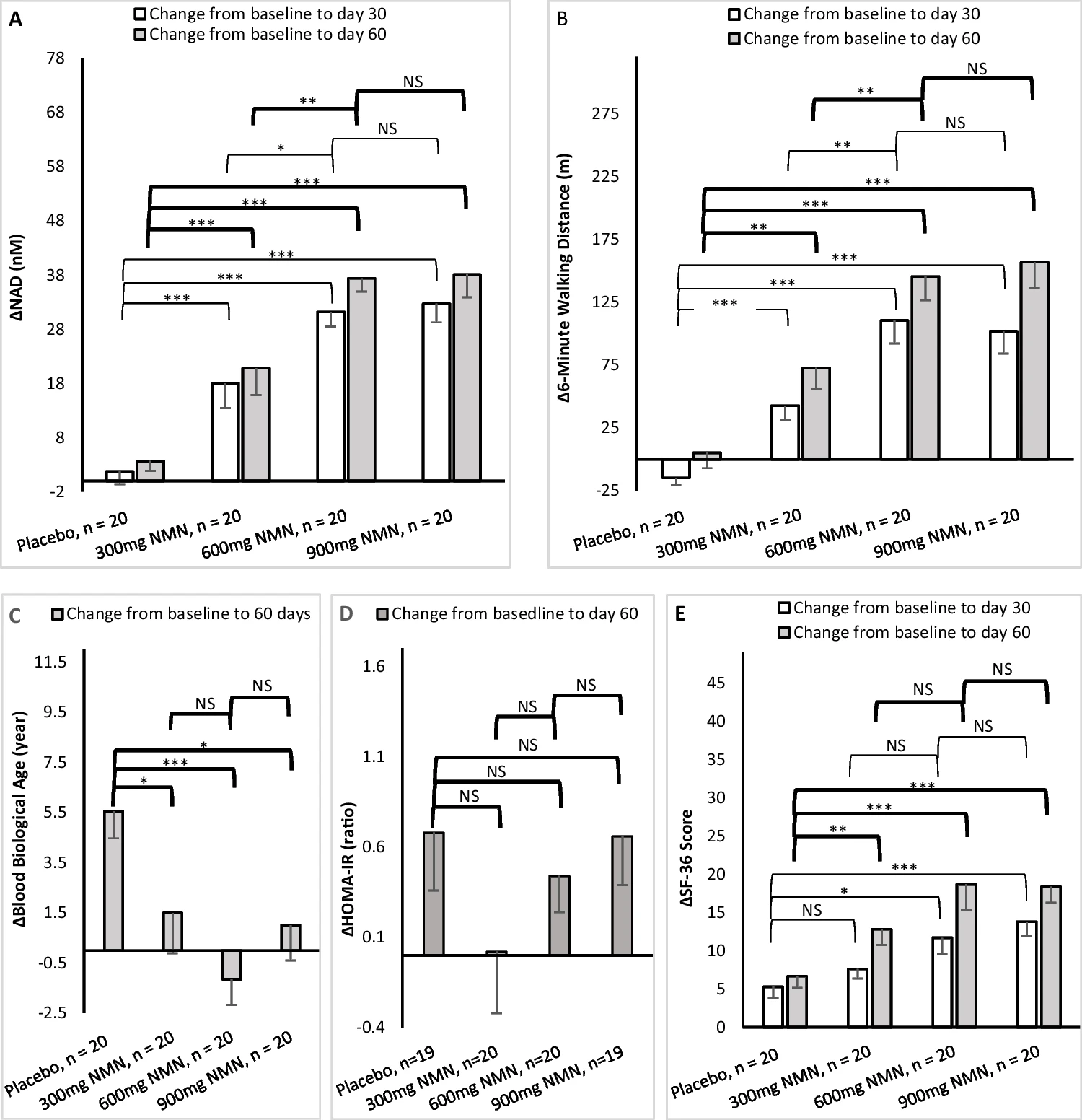
Efficacy of the placebo and three NMN -treated groups, comparisons of the three treated groups vs. placebo, 600 mg vs. 300 mg, and 900 mg vs. 600 mg on the changes of efficacy (Δmean ± SEM) from baseline to day 30 and/or day 60.
Efficacy of the placebo and three NMN-treated groups, comparisons of the three treated groups vs. placebo, 600 mg vs. 300 mg, and 900 mg vs. 600 mg on the changes of efficacy (Δmean ± SEM) from baseline to day 30 and/or day 60. Image source from Springer.

NAD⁺ levels increased significantly in all NMN groups

NMN supplementation appears safe and well tolerated

Walking distance improved in NMN groups

Biological age decreased in NMN groups

Quality of life scores improved

Understanding the effects of NMN

This clinical trial provides strong evidence that NMN supplementation is both safe and effective for healthy middle-aged adults. With significant improvements in NAD⁺ levels, endurance, biological age, and quality of life, NMN shows real potential as part of a healthy aging strategy.

If you’re curious about integrating NMN into your daily routine, take a look at our NMN supplements here — and feel the difference it can make in your everyday energy.

References
  1. Yi L, Maier AB, Tao R, Lin Z, Vaidya A, Pendse S, Thasma S, Andhalkar N, Avhad G, Kumbhar V. The efficacy and safety of β-nicotinamide mononucleotide (NMN) supplementation in healthy middle-aged adults: a randomized, multicenter, double-blind, placebo-controlled, parallel-group, dose-dependent clinical trial. GeroScience. 2022 Dec 8;45(1):29–43. doi:10.1007/s11357-022-00705-1. PMID: 36482258; PMCID: PMC9735188.

Close

Search

Select your Language and Currency preferences

purovitalis AURA

Get exclusive access to personalized health insights

Sign up for a 7-day free trial of our AI-powered app and take the first step towards a younger, healthier you.

or get full access with your product subscription!

Privacy Policy

Section 1 – What do we do with your information?

When you purchase something from our store, as part of the buying and selling process, we collect the personal information you give us such as your name, address and email address.

When you browse our store, we also automatically receive your computer’s internet protocol (IP) address in order to provide us with information that helps us learn about your browser and operating system.

Email marketing (if applicable): With your permission, we may send you emails about our store, new products and other updates.

Section 2 – Consent

How do you get my consent?

When you provide us with personal information to complete a transaction, verify your credit card, place an order, arrange for a delivery or return a purchase, we imply that you consent to our collecting it and using it for that specific reason only.

If we ask for your personal information for a secondary reason, like marketing, we will either ask you directly for your expressed consent, or provide you with an opportunity to say no.

How do I withdraw my consent?

If after you opt-in, you change your mind, you may withdraw your consent for us to contact you, for the continued collection, use or disclosure of your information, at anytime, by contacting us at: [email protected] or mailing us at: Purovitalis Inc, 181 Bay Street, STE 1800, Toronto, Ontario, Canada, M5J 2T9

Section 3 – Disclosure

We may disclose your personal information if we are required by law to do so or if you violate our Terms of Service.

Payment:

If you choose a direct payment gateway to complete your purchase, then CureSupport stores your credit card data. It is encrypted through the Payment Card Industry Data Security Standard (PCI-DSS). Your purchase transaction data is stored only as long as is necessary to complete your purchase transaction. After that is complete, your purchase transaction information is deleted.

All direct payment gateways adhere to the standards set by PCI-DSS as managed by the PCI Security Standards Council, which is a joint effort of brands like Visa, MasterCard, American Express and Discover.

PCI-DSS requirements help ensure the secure handling of credit card information by our store and its service providers.

Section 4 – Third-party services

In general, the third-party providers used by us will only collect, use and disclose your information to the extent necessary to allow them to perform the services they provide to us.

However, certain third-party service providers, such as payment gateways and other payment transaction processors, have their own privacy policies in respect to the information we are required to provide to them for your purchase-related transactions.

For these providers, we recommend that you read their privacy policies so you can understand the manner in which your personal information will be handled by these providers.

In particular, remember that certain providers may be located in or have facilities that are located in a different jurisdiction than either you or us. So if you elect to proceed with a transaction that involves the services of a third-party service provider, then your information may become subject to the laws of the jurisdiction(s) in which that service provider or its facilities are located.

As an example, if you are located in Canada and your transaction is processed by a payment gateway located in the United States, then your personal information used in completing that transaction may be subject to disclosure under United States legislation, including the Patriot Act.

Once you leave our store’s website or are redirected to a third-party website or application, you are no longer governed by this Privacy Policy or our website’s Terms of Service.

Links

When you click on links on our store, they may direct you away from our site. We are not responsible for the privacy practices of other sites and encourage you to read their privacy statements.

Section 5 – Security

To protect your personal information, we take reasonable precautions and follow industry best practices to make sure it is not inappropriately lost, misused, accessed, disclosed, altered or destroyed.

If you provide us with your credit card information, the information is encrypted using secure socket layer technology (SSL) and stored with a AES-256 encryption.  Although no method of transmission over the Internet or electronic storage is 100% secure, we follow all PCI-DSS requirements and implement additional generally accepted industry standards.

Section 6 – Age of consent

By using this site, you represent that you are at least the age of majority in your state or province of residence, or that you are the age of majority in your state or province of residence and you have given us your consent to allow any of your minor dependents to use this site.

Section 7 – Changes to this privacy policy

We reserve the right to modify this privacy policy at any time, so please review it frequently. Changes and clarifications will take effect immediately upon their posting on the website. If we make material changes to this policy, we will notify you here that it has been updated, so that you are aware of what information we collect, how we use it, and under what circumstances, if any, we use and/or disclose it.

If our store is acquired or merged with another company, your information may be transferred to the new owners so that we may continue to sell products to you.

Questions and contact information

If you would like to: access, correct, amend or delete any personal information we have about you, register a complaint, or simply want more information contact our Privacy Compliance Officer at [email protected].

Prof. Dr. Andrea Maier

Prof. Dr. Andrea Maier is an internist and professor of aging (“ longevity medicine ”) at the Vrije Universiteit in Amsterdam and the University of Melbourne, Australia. She studies the aging body and searches for anti-aging treatments. She heads the Center for Healthy Longevity in Singapore.
Why do we gradually decline during our average life of more than 80 years? Can we stop that process? Or maybe even turn around? And to what extent should we really want that? Maier gives practical tips on how we can extend our lifespan while also staying healthy.

Topics Andrea Maier talks about

  • Health
  • Aging and rejuvenation
  • Interventions to reverse aging
  • Gerontology
  • Innovation in medicine
  • Medicine


Background Andrea Maier

Andrea Maier graduated in Medicine from the University of Lübeck in 2003. She specialized in internal medicine at the Leiden University Medical Center and subsequently chose the subspecialty of Geriatric Medicine. This is where she started her research into aging.

Why Subscription?

Exclusive Perks

Convenience

Save 16% on Each Renewal

Consistency

Time-Saving