

Indholdsfortegnelse
If you care about energy, recovery, or healthy aging, you’ll meet NAD+ fast. Cells use it to turn food into ATP, repair DNA, and run stress-response enzymes. Levels slide with age, which is why raising NAD+ is getting so much attention. A 2025 Aldrende natur review pulls together what we know from human trials and where each precursor fits.
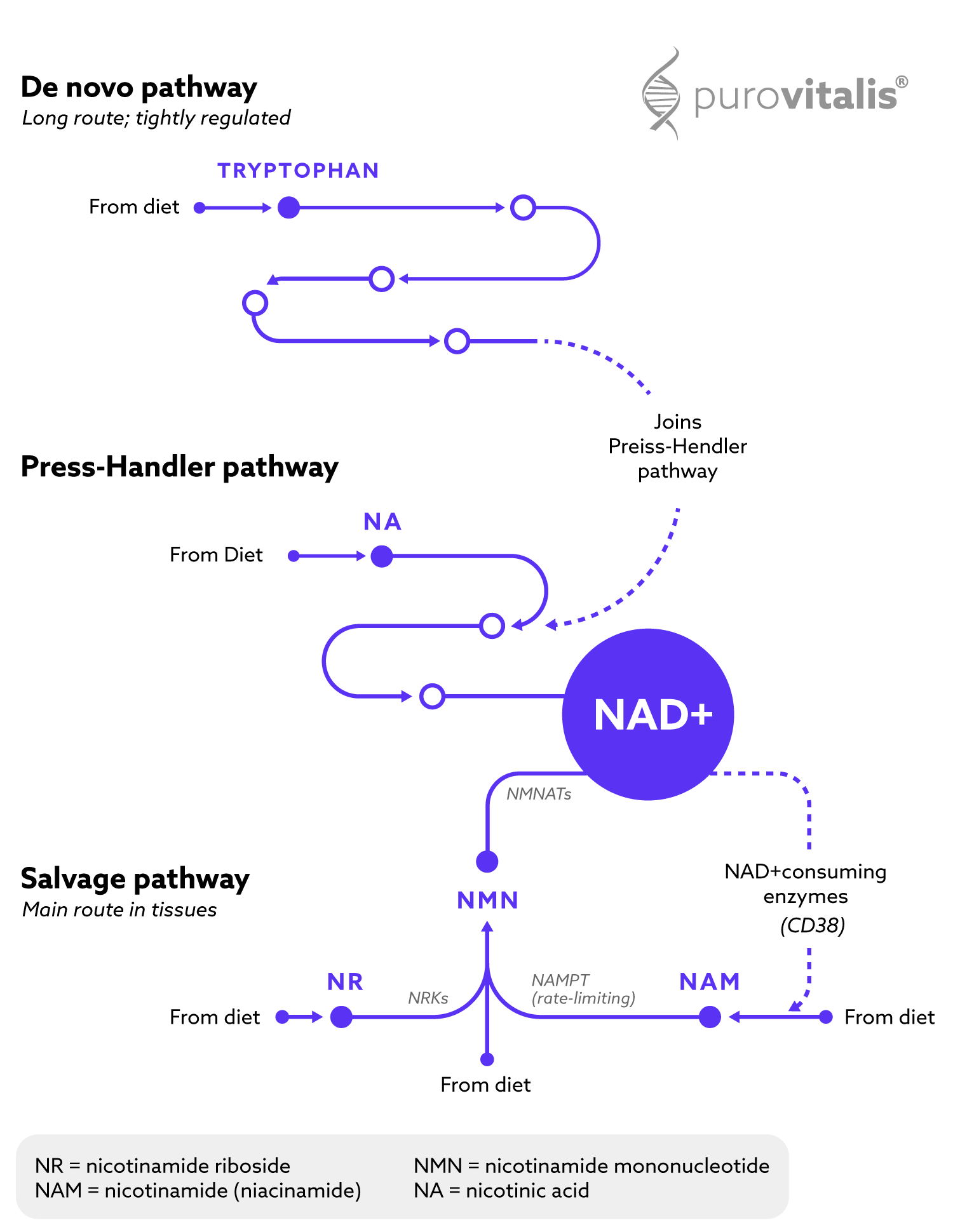
The pathways in one minute
Your body makes NAD+ in three routes:
- Salvage (main route in most tissues): recycles nicotinamide (NAM) back to NAD+ via NAMPT. NR → NMN → NAD+; NMN → NAD+.
- Preiss–Handler: uses niacin (NA).
- De novo: starts from tryptophan through the kynurenine pathway and converges later; slow and tightly regulated
Learn more: What is NAD+ and why is it important for aging?
At-a-glance: NAD+ precursors comparison
| Precursor | How it feeds NAD+ | Human evidence | Efficacy | Key positives | Watch-outs / notes |
|---|---|---|---|---|---|
| Nikotinamidribosid (NR) | Salvage → NMN → NAD+ | Multiple human trials; strong rises in blood/brain NAD+ | High | Good human data; well tolerated | Some outcomes mixed; stick to studied doses |
| Nicotinamide mononucleotide (NMN) | Salvage → NAD+ | Placebo-controlled trials; boosts NAD+; early functional benefits | High | Encouraging RCT results; safe in trials | Quality matters; limited long-term data |
| Nicotinamide (NAM) | Salvage via NAMPT → NMN → NAD+ | Raises NAD+; vitamin B3 form | Moderate | Affordable; widely available | High doses may blunt sirtuins |
| Nicotinic acid (NA) | Preiss–Handler → NAD+ | Raises NAD+; clinical lipid use | Moderate | Long history; effective | Flushing common at typical doses |
| NRH | Reduced NR → rapid entry | No human trials; strong preclinical boosts | Potentially more potent | Large NAD+ rises in animals | Inflammatory signals in vitro; safety unknown |
| NMNH | Reduced NMN → NAD+/NADH | No human data; preclinical boosts | Potentially more potent | Higher boosts in early models | Stability and safety unclear |
| Tryptophan | De novo → NAD+ | Minor contribution; not efficient in tissues | Low | Dietary amino acid | Slow, regulated; not practical for boosting |
| Precursor | Evidence | Efficacy |
|---|---|---|
| NR Salvage → NMN → NAD+ | Multiple human trials; strong rises in blood/brain NAD+ | High |
| NMN Salvage → NAD+ | RCTs; boosts NAD+; early functional benefits | High |
| NAM Vitamin B3 | Raises NAD+; high doses may blunt sirtuins | Moderate |
| NA Vitamin B3 | Raises NAD+; effective but flushing | Moderate |
| NRH Reduced NR | Preclinical only; large boosts | Potentially more potent |
| NMNH Reduced NMN | Preclinical only; stronger than NMN | Potentially more potent |
| Tryptophan De novo pathway | Minor contribution in humans | Low |
Note:
In the Aldrende natur review, NR og NMN are highlighted as the most studied in humans. NA og NAM are established vitamins. NRH og NMNH are emerging with strong preclinical signals but limited human data.
Safety and future directions
An important question is: Are NAD+ boosters safe, especially for long-term use? So far, early trials paint a reassuring picture. Both NR and NMN have shown good safety profiles in human studies . For instance, multiple studies report that daily doses of 1,000 mg or more of NR are well tolerated, with no serious side effects . Similarly, a clinical trial of NMN at 1,250 mg per day for 4 weeks found it to be safe and caused no significant adverse effects in healthy men and women . Participants taking these supplements generally have NAD+ levels go up with minimal downsides – at most, some people report mild symptoms like nausea or fatigue, but those are infrequent.
That said, experts caution that we still need more research before NAD+ boosters can be considered proven anti-aging therapies . Most human trials so far have been short (a few weeks to months) and in relatively small groups. It remains to be seen what happens with continuous, long-term NAD+ supplementation over years. Will the benefits hold up or grow? Are there any hidden risks of keeping NAD+ elevated chronically? Large-scale and longer-duration studies are currently in progress to answer these questions .
Another area of ongoing research is identifying the optimal dosing and timing for NAD+ boosters . Future studies may find that certain groups of people (based on age, genetics, or health status) respond better than others. Scientists are also exploring new NAD+-boosting molecules and improved delivery methods. For example, CD38 inhibitors (to reduce NAD+ breakdown) or novel precursors (sometimes called “second-generation” NAD+ boosters) could work alongside NR or NMN for an even bigger effect . Formulations like liposomal NAD+ precursors or sustained-release capsules are being developed to increase bioavailability, meaning more NAD+ gets into cells where it’s needed.
The 7 NAD+ precursors explained
1. Nicotinamide riboside (NR)
NR is a form of vitamin B3 naturally found in trace amounts in milk. In the salvage pathway, NR converts into NMN and then into NAD+.
Human evidence: Multiple clinical trials show NR can significantly raise NAD+ in blood and muscle. In some studies, NAD+ nearly doubled compared to baseline. NR has been tested up to 2,000 mg/day and is generally well tolerated.
Efficacy: High.
Learn more: What is NR?
2. Nicotinamide mononucleotide (NMN)
NMN is one step away from NAD+, making it a direct precursor in the salvage pathway.
Human evidence: Placebo-controlled trials have shown NMN raises NAD+ in blood. Some studies report improved insulin sensitivity in women with prediabetes and better walking speed in older men. Safety data looks promising up to 1,200 mg/day.
Efficacy: High
Learn more: Hvad er NMN?
3. Nicotinamide (NAM)
NAM, also known as niacinamide, is the standard vitamin B3 form found in many multivitamins. It’s recycled into NAD+ via the NAMPT enzyme.
Human evidence: NAM increases NAD+ levels, but very high doses can block sirtuins — enzymes linked to longevity.
Efficacy: Moderate.
4. Nicotinic acid (NA, niacin)
NA is another vitamin B3 form. It feeds NAD+ production through the Preiss–Handler pathway.
Human evidence: NA raises NAD+ but often causes flushing at common doses. It’s also been used for decades at high doses for lipid management under medical supervision.
Efficacy: Moderate.
5. NRH (dihydronicotinamide riboside)
NRH is the reduced form of NR and enters the NAD+ pool quickly.
Human evidence: No published trials yet. In cells and animal models, NRH raises NAD+ more strongly than NR. However, some studies show it can trigger inflammatory gene activity in immune cells.
Efficacy: Potentially more potent than NR, but unproven in humans.
6. NMNH (reduced NMN)
NMNH is the reduced form of NMN. It can funnel into both NAD+ and NADH pools.
Human evidence: None so far. Early preclinical work suggests it may be even more efficient than NMN in raising NAD+ in tissues. Stability and safety in humans remain unclear.
Efficacy: Potentially more potent than NMN, but unproven in humans.
7. Tryptophan
Tryptophan is an essential amino acid found in dietary protein. It supports NAD+ production through the long de novo (kynurenine) pathway.
Human evidence: While tryptophan contributes to NAD+ in the liver, this pathway is slow and tightly regulated, so supplementation doesn’t meaningfully boost NAD+ in most tissues.
Efficacy: Low.
Hallmarks of aging: where NAD+ fits
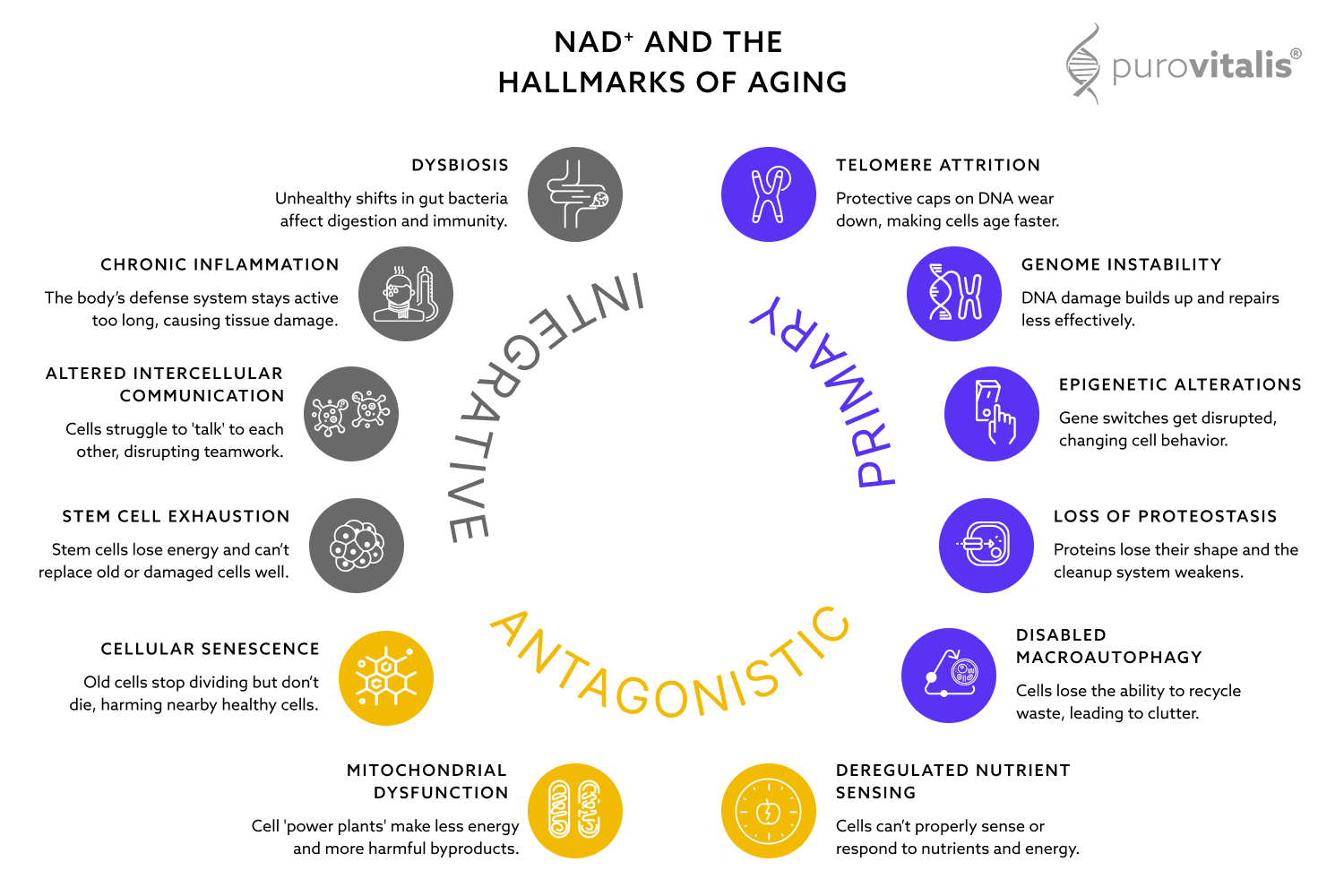
NAD+ touches several hallmarks: DNA repair (PARPs), epigenetic regulation and mitochondrial function (sirtuiner), and inflammation/senescence. CD38 rises with age and breaks down NAD+ (and can metabolize NMN), which helps explain age-related decline. Preserving or restoring NAD+ supports these maintenance systems.
Læs mere on the Hallmarks of aging
A Note on CD38:
CD38 is an enzyme that breaks down NAD+ and even consumes NMN. Its activity rises with age and inflammation, which accelerates NAD+ decline. In animal studies, blocking CD38 preserved NAD+ and improved health markers. Human-ready CD38 inhibitors are still in research, but this enzyme is a big reason why precursors like NR and NMN are being studied in older adults.
Buyer’s guide (quick and practical)
Most readers ask, “Which one should I try?” Based on human data today:
- Start with NR or NMN. Both raise NAD+ reliably in people; choose the format you prefer and stay consistent for 8–12 weeks.
- Niacin (NA) works but expect flushing; talk to a clinician if you have lipid or glucose issues.
- NAM is fine at typical vitamin doses. Avoid very high chronic doses if your goal is sirtuin-linked benefits.
- NRH og NMNH look strong in the lab but aren’t ready for routine use without human data.
Vores tip:
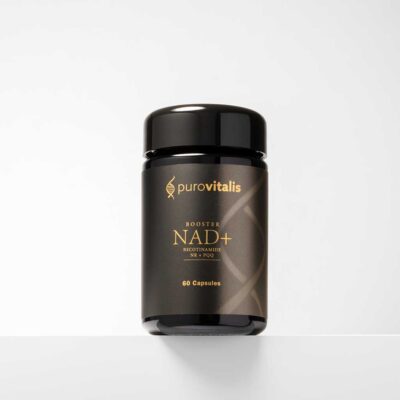
Not sure which nad+ precursor fits you? Try a side-by-side month: Purovitalis NMN one month, NAD Booster (NR + NAM) the next month. Track sleep, afternoon energy, training recovery, and any wearable metrics. People respond differently; a short self-trial is the easiest way to see what works for you.
Conclusion and next steps
Raising NAD+ is a practical way to support cellular energy, repair, and resilience as we age. NR and NMN stand out today for human data; vitamins NA and NAM help with some trade-offs; NRH/NMNH are promising but need trials. Use the table to choose a starting point, then test and track.
For health-conscious individuals, maintaining NAD+ levels might become part of a proactive wellness strategy. Simple steps like regular exercise and a balanced diet can support NAD+ metabolism (for example, exercise boosts the NAD+-producing enzyme NAMPT). On top of that, NAD+ precursor supplements are available for those who want to try this biohack for potential extra support.
Want to learn more about NMN and NR? Read our extend comparison.
Which NAD+ precursor has the most human data?
NR and NMN. Both raise blood NAD+ in randomized human trials.
How fast do levels rise?
In NR studies, whole-blood NAD+ rose within 1–2 weeks and stayed elevated during supplementation.
Is NMN’s effect shown in people?
Yes. A 10-week RCT in postmenopausal women with prediabetes reported higher NAD+ and improved muscle insulin sensitivity.
Does tryptophan boost NAD+ meaningfully?
Not in a practical sense for healthy people; the de novo route is slow and tightly regulated.
Are high doses of NAM a good idea?
NAM raises NAD+, but very high chronic doses can counter sirtuin activity; stick to standard vitamin ranges unless advised otherwise.
What about NRH and NMNH?
Preclinical data look strong, but published human efficacy is lacking right now. Treat them as “emerging.”
Is it safe to raise NAD+?
Early human trials of NR and NMN report good tolerability at commonly studied doses; long-term outcomes still need larger studies.
Referencer
- Zhang, J., Wang, HL., Lautrup, S. David Sinclair og andre. Emerging strategies, applications and challenges of targeting NAD+ in the clinic. Nat Aging 5, 1704–1731 (2025). https://doi.org/10.1038/s43587-025-00947-6
- Brage Brakedal, Christian Dölle, Frank Riemer, Yilong Ma, Gonzalo S. Nido, Geir Olve Skeie, Alexander R. Craven, Thomas Schwarzlmüller, Njål Brekke, Joseph Diab, Lars Sverkeli, Vivian Skjeie, Kristin Varhaug, Ole-Bjørn Tysnes, Shichun Peng, Kristoffer Haugarvoll, Mathias Ziegler, Renate Grüner, David Eidelberg, Charalampos Tzoulis, study: A randomized phase I trial of nicotinamide riboside supplementation in Parkinson’s disease, Cell Metabolism,https://doi.org/10.1016/j.cmet.2022.02.001.
- Yi L, Maier AB, Tao R, Lin Z, Vaidya A, Pendse S, Thasma S, Andhalkar N, Avhad G, Kumbhar V. The efficacy and safety of β-nicotinamide mononucleotide (NMN) supplementation in healthy middle-aged adults: a randomized, multicenter, double-blind, placebo-controlled, parallel-group, dose-dependent clinical trial. GeroVidenskab. 2022 Dec 8;45(1):29–43. doi:10.1007/s11357-022-00705-1. PMID: 36482258; PMCID: PMC9735188.



 English
 Dutch
Dutch German
 French
 Spanish
 Romanian
 Danish
 Italian